

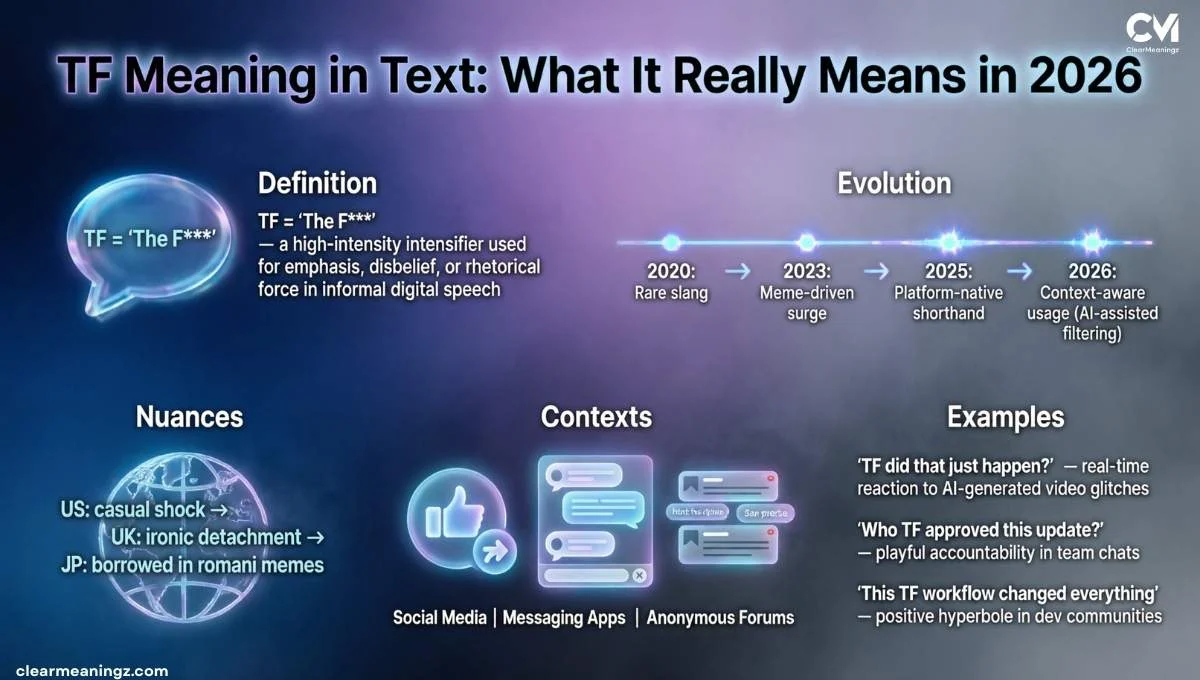
If you’ve ever scrolled through social media or read a text that left you wondering, “what does tf mean?” — you’re not alone.
- What Does TF Mean in Text Messages?
- What Does TF Mean on Social Media?
- Is TF Offensive? Understanding Tone and Context
- The Origins of TF in Internet Slang
- Different Meanings of TF Depending on Context
- Why Abbreviations Like TF Are So Popular
- How to Use TF Appropriately
- The Psychology Behind Intensifiers Like TF
- Real-World Example: Context Changes Meaning
- Common Misinterpretations
- Frequently Asked Questions
- Meta Title (SEO Optimized)
- Meta Description (SEO Optimized)
- Conclusion: What Does TF Mean and Should You Use It?
- you may also read
In today’s fast-paced digital world, abbreviations evolve almost daily. From TikTok captions to Twitter threads and casual WhatsApp chats, short forms like “TF” are everywhere. But depending on the context, the meaning can shift dramatically.
In this in-depth guide, we’ll break down what does TF mean, how it’s used, where it came from, and when you should (or shouldn’t) use it. We’ll also look at how abbreviations like this spread across pop culture — from sports communities discussing a jockey to local conversations in places like Wermelskirchen — and why understanding context is everything.
Let’s decode it properly
Table of Contents
ToggleWhat Does TF Mean in Text Messages?
Let’s address the core question directly: what does tf mean in texting?
In most cases, TF stands for “the f*”** (where the “f” represents a swear word). It’s commonly used to express:
- Surprise
- Confusion
- Shock
- Frustration
- Disbelief
For example:
- “What TF is going on?”
- “Where TF are you?”
- “How TF did that happen?”
In these sentences, TF intensifies the emotion behind the statement. It adds emphasis and emotional weight.
Instead of typing the full explicit word, people shorten it to “TF” to:
- Save time
- Avoid direct profanity
- Stay within platform guidelines
- Sound more casual
So when someone asks, what does tf mean? — the most common answer is that it’s an intensified form of “what the heck” or “what the hell,” often stronger depending on tone.
What Does TF Mean on Social Media?
If you’re still wondering what does tf mean in the world of Instagram, TikTok, or X (formerly Twitter), the meaning is largely the same — but tone varies widely.
On platforms like:
- TikTok
- Snapchat
- X
TF is used in captions, comments, memes, and reaction posts.
Examples:
- “TF did I just watch?”
- “Why TF is this trending?”
- “Who TF approved this?”
It’s common in viral culture where quick, emotionally charged reactions dominate.
For instance, imagine a controversial sports moment involving a famous jockey. A post about a dramatic race result might spark comments like:
- “TF was that finish?”
- “How TF did the jockey lose that?”
In online communities, especially those passionate about sports or public figures — like discussions about a jockey freundin (German for “jockey’s girlfriend”) or local sports news in Wermelskirchen — abbreviations like TF add emotional punch to real-time reactions.
The key is tone: on social media, TF often reads as humorous exaggeration rather than genuine anger.
Is TF Offensive? Understanding Tone and Context
A critical part of understanding what does tf mean is recognizing when it might cross a line.
Because TF represents a swear word, it can:
- Sound aggressive
- Feel disrespectful
- Appear unprofessional
- Be inappropriate in formal settings
For example:
❌ Professional email:
“Why TF hasn’t this been completed?”
✅ Casual group chat:
“Why TF is this taking so long 😂”
Context matters enormously.
In academic, business, or formal communication, avoid using TF entirely. In casual texting among friends, it’s usually acceptable — depending on your relationship and shared communication style.
When in doubt, ask yourself:
- Would I say this in person?
- Is this platform appropriate for slang?
- Could this offend someone?
Understanding what does tf mean includes understanding how it may be perceived.
The Origins of TF in Internet Slang
Internet shorthand developed alongside early SMS messaging, where character limits forced creativity.
TF emerged as part of a broader wave of abbreviations like:
- WTF (what the f***)
- AF (as f***)
- IDK (I don’t know)
- IMO (in my opinion)
As texting culture grew in the early 2000s, platforms like:
- MySpace
helped normalize abbreviations.
Today, slang spreads rapidly through TikTok trends and meme culture.
Interestingly, language compression isn’t new. Linguists have long studied how communication evolves under constraint. According to research from institutions like Stanford University’s Linguistics Department, digital communication accelerates linguistic adaptation.
So if you’re asking what does tf mean, you’re witnessing language evolution in real time.
Different Meanings of TF Depending on Context
Although the most common answer to what does tf mean is “the f***,” there are alternative meanings depending on industry or context.
1. In Gaming
TF may refer to:
- Team Fortress (often abbreviated as TF, especially in gaming communities)
For example:
“Are you playing TF tonight?”
2. In Photography
TF can mean:
- Trade for (used in model-photographer collaborations)
Example:
“TF shoot this weekend?”
3. In Finance or Business
TF may stand for:
- Transfer
- Task Force
- Transaction Fee
In these cases, TF has no connection to profanity at all.
4. In German Contexts
In German-speaking areas like Wermelskirchen, English slang such as TF is increasingly common among younger audiences online. However, its meaning may not be immediately clear to older generations.
That’s why context is critical when interpreting abbreviations.
Why Abbreviations Like TF Are So Popular
To truly understand what does tf mean, we need to explore why abbreviations thrive.
1. Speed
Typing “TF” is faster than typing the full phrase.
2. Emotional Intensity
It delivers strong emotional impact in just two letters.
3. Cultural Belonging
Using slang signals that you’re part of an online community.
4. Platform Restrictions
Some social platforms flag explicit words. TF avoids automatic moderation while still communicating emotion.
Language online mirrors spoken conversation — but faster, shorter, and more reactive.
How to Use TF Appropriately
If you plan to use it, here are best practices:
✅ Appropriate Situations
- Casual chats with friends
- Social media captions
- Meme responses
- Informal gaming communities
❌ Avoid Using TF In:
- Professional emails
- Academic writing
- Customer service interactions
- Public-facing brand communication
If you’re unsure whether to use it, substitute with:
- “What on earth…”
- “Seriously?”
- “What is going on?”
These alternatives maintain emotion without risk.
Understanding what does tf mean also means knowing when not to use it.
The Psychology Behind Intensifiers Like TF
Why do people use intensifiers at all?
Emotionally charged language:
- Strengthens social bonding
- Signals urgency
- Expresses authenticity
- Attracts attention
In fast-moving digital spaces, subtlety often gets ignored. Strong expressions stand out.
However, overuse reduces impact. If every sentence contains TF, it loses emphasis and may appear immature.
Balance is key.
Real-World Example: Context Changes Meaning
Imagine three scenarios:
- A jockey loses a race unexpectedly.
- Fan reaction: “How TF did that happen?”
- A friend texts from Wermelskirchen after a train delay.
- “Where TF is this train?”
- A formal meeting email:
- “Why TF was the budget changed?” (Not appropriate)
Same abbreviation. Completely different appropriateness.
This highlights why understanding what does tf mean goes beyond definition — it requires social awareness.
Common Misinterpretations
Some people assume TF always equals “WTF.” That’s not entirely correct.
- WTF = “What the f***”
- TF alone = “the f***” (used inside a sentence)
Example:
“What TF is this?”
Instead of: “What the f*** is this?”
It’s a subtle but important distinction.
Frequently Asked Questions
1. What does TF mean in texting?
In texting, TF usually stands for “the f***” and is used to express confusion, anger, or surprise.
2. Is TF the same as WTF?
Not exactly. WTF stands for “what the f***,” while TF is often used within a sentence for emphasis.
3. Is TF rude?
It can be. Because it references profanity, it may sound aggressive depending on tone and context.
4. Can TF mean something else?
Yes. In gaming, it can refer to Team Fortress. In business, it may stand for task force or transfer.
5. Should I use TF in professional settings?
No. Avoid using slang abbreviations like TF in formal or professional communication.
Meta Title (SEO Optimized)
What Does TF Mean? Full Guide to TF in Text & Social Media
Meta Description (SEO Optimized)
What does TF mean? Discover the full meaning of TF in text messages, social media, and slang, plus when and how to use it correctly.
Conclusion: What Does TF Mean and Should You Use It?
So, what does tf mean?
In most digital conversations, it stands for “the f***” — an intensifier used to express strong emotion like shock, confusion, or frustration.
But meaning alone isn’t enough. Context defines whether it sounds funny, dramatic, aggressive, or inappropriate.
Language evolves quickly. From casual sports debates about a jockey to local online chats in Wermelskirchen, abbreviations like TF shape how we communicate today.
Use it wisely. Understand your audience. And remember — just because slang is common doesn’t mean it’s always suitable.
If you found this guide helpful, leave a comment below with other slang terms you’d like explained. Don’t forget to subscribe for more clear, in-depth language breakdowns designed to keep you ahead of digital trends